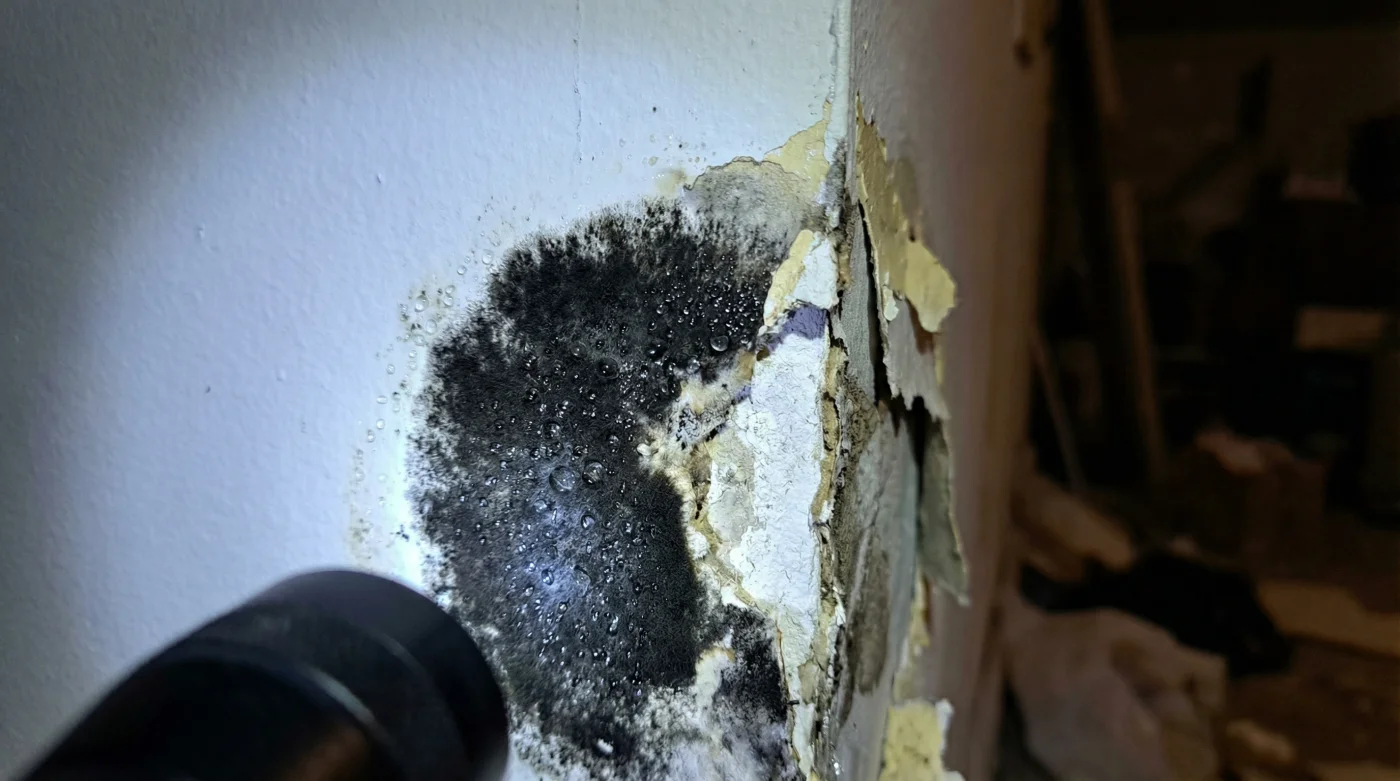
You step back, the harsh sting of chlorine fading from your eyes, wiping a bead of sweat from your forehead. The bathroom wall, previously stained with a creeping, dark shadow, is now pristine and white. You feel a sudden rush of domestic victory. The air smells sharp and clinical, the scent of total eradication.
But behind that crisp white drywall paper, a silent, invisible mechanism is already spinning into motion. The chemical you just sprayed did not end the invasion; it merely hid the evidence.
This is the great illusion of household maintenance. We treat our homes like hard, impermeable surfaces, forgetting that drywall is effectively a sponge made of pressed dust and paper. When you spray a heavy liquid over a dark organic stain, you are trusting a fast surface reaction over the deep structural reality of the wall.
By tomorrow morning, the moisture from your cleaning solution will sink deep into the gypsum. You have not eradicated a problem—you have quietly watered a hidden garden.
The Illusion of Eradication
Think of common household bleach not as a weapon against organic growth, but as a severe cosmetic alteration. When it touches porous materials like your drywall, the chemical structure interacts directly with the melanin inside the microscopic spores. It strips away the dark pigment, bleaching the growth until it becomes entirely transparent.
Because the dark spots vanish before your eyes, your brain registers the task as finished. But standard household bleach is mostly composed of water. The heavy chlorine molecules sit on top of the drywall, too large to penetrate the painted paper surface. Meanwhile, the water content sinks right through the barrier.
Down in the dark, the microscopic root structures—the mycelium—drink in that freshly provided moisture. You fed the subterranean system while simultaneously erasing the warning lights on your wall. The growth will return in a few weeks, reaching further across the stud bay, fortified by the very liquid you used to fight it.
Consider Elias Vance, a 42-year-old remediation specialist working the humid coastal lines of Florida. After pulling out entire rotting stud walls from supposedly clean properties, Elias realized this chemical approach was creating an epidemic of false security. ‘People treat organic growth like everyday dirt,’ Elias notes while running a moisture meter over a crumbling baseboard, ‘but it operates like a living network. Hitting drywall with bleach is exactly like shaving a weed down to the soil and then heavily watering the roots.’ He stopped using chlorine-based products entirely a decade ago, relying instead on penetrating solutions that break down the protein structures below the surface.
Adapting Your Approach to the Surface
The way you handle an intrusion depends entirely on what the organism is using for food. The material always dictates your response. You must evaluate the structural diet before choosing your physical intervention.
The Painted Shell
If your drywall is coated in heavy semi-gloss paint, the intrusion might genuinely exist only on the slick surface layer. The paint acts as a resin shield. Here, a simple mix of mild dish soap and warm water is enough to lift the spores without feeding the deeper paper backing.
The Raw Paper
This is the danger zone. Flat matte paint offers zero resistance. Liquid sinks immediately into the paper backing, reaching the glue and gypsum underneath. For these vulnerable stretches, you need rapid-evaporation treatments that penetrate deeply without leaving a lingering pool of moisture.
The Deep Saturation
When the drywall feels soft or gives slightly under the gentle pressure of your thumb, no surface treatment will save it. The structural integrity is permanently compromised. The only cure here is a sharp utility knife, a square cut, and a fresh patch of new material.
The Root Protocol
To stop the spread, you must pivot away from harsh surface chemicals to acidic or oxidizing agents. These specific liquids penetrate the cellular walls of the organism without leaving a massive reservoir of water behind in your walls.
- Dawn dish soap ruins protective coatings on hardwood floors
- Major hardware chains pull Roundup weed killer from shelves
- Cedar mulch attracts invasive termites to suburban home foundations
- New federal appliance regulations target specific gas stove models
- White vinegar permanently etches granite countertops within ten minutes
- The Agent: 3 percent Hydrogen peroxide or standard distilled white vinegar. Never mix them together. Both possess the molecular weight required to penetrate porous materials.
- The Application: A fine-mist spray bottle to avoid pooling water on the baseboards.
- The Time: Exactly 10 minutes of undisturbed contact. Do not touch the wall while it works.
- The Removal: A damp microfiber cloth, wiped in a single, downward direction. Never scrub back and forth in circles.
Pour your chosen solution into the spray bottle completely undiluted. Mist the area lightly until it just begins to shine under the room lighting. Do not let it drip down the wall. Stand back and wait. The liquid will quietly fizz or sit still, breaking down the organism at a molecular level, right down to the root.
A Quiet Equilibrium
True maintenance rarely relies on aggressive, burning chemicals. We are conditioned to associate the sharp smell of chlorine and burning eyes with domestic safety, believing that a harsh odor means we have successfully protected our living spaces.
But a healthy home operates softly. By understanding how materials breathe and how moisture travels through your walls, you step away from panic-driven chemical reactions. You learn to read the physical environment around you.
Letting go of the bleach bottle is about trusting quiet science over loud, immediate results. When you handle your walls with precise, biological awareness, you aren’t just wiping down a room. You are fostering a dry, stable atmosphere where future problems simply cannot take root.
True remediation isn’t about destroying what you see; it is about altering the environment so nothing unwanted can survive in what you cannot see. – Elias Vance
| Key Point | Detail | Added Value for the Reader |
|---|---|---|
| Standard Bleach | High water content, large chlorine molecules stay on the surface. | You save time and prevent worse regrowth by avoiding it entirely. |
| Distilled Vinegar | Mildly acidic, penetrates porous drywall paper to reach mycelium. | Offers a cheap, non-toxic way to permanently kill the root system. |
| Hydrogen Peroxide | Oxidizes the cellular structure of the organism upon contact. | Lifts stains slightly while breaking down the hidden biological network. |
Frequently Asked Questions
Will painting over the spots kill the organism?
No. Standard paint simply traps the moisture and the spores inside the wall, giving them a dark, humid space to spread laterally. The paint will eventually bubble and peel.
Why does my bathroom always smell musty even after cleaning?
The musty smell is the off-gassing of active biological growth inside the walls or under the caulk line. Surface cleaning ignores the hidden colonies producing the odor.
Can I use bleach on bathroom tiles instead?
Yes, bleach works perfectly on non-porous surfaces like glazed ceramic or glass. The issue only arises when it contacts grout, drywall, or raw wood.
How long should vinegar sit on the wall?
Allow it to rest for at least 10 minutes. It takes time for the acidity to penetrate the microscopic cell walls and neutralize the organism.
Should I run a fan while treating the wall?
Keep the air still during the initial spray and wipe to prevent blowing loose spores across the room. Turn the exhaust fan on only after you have wiped the wall clean.