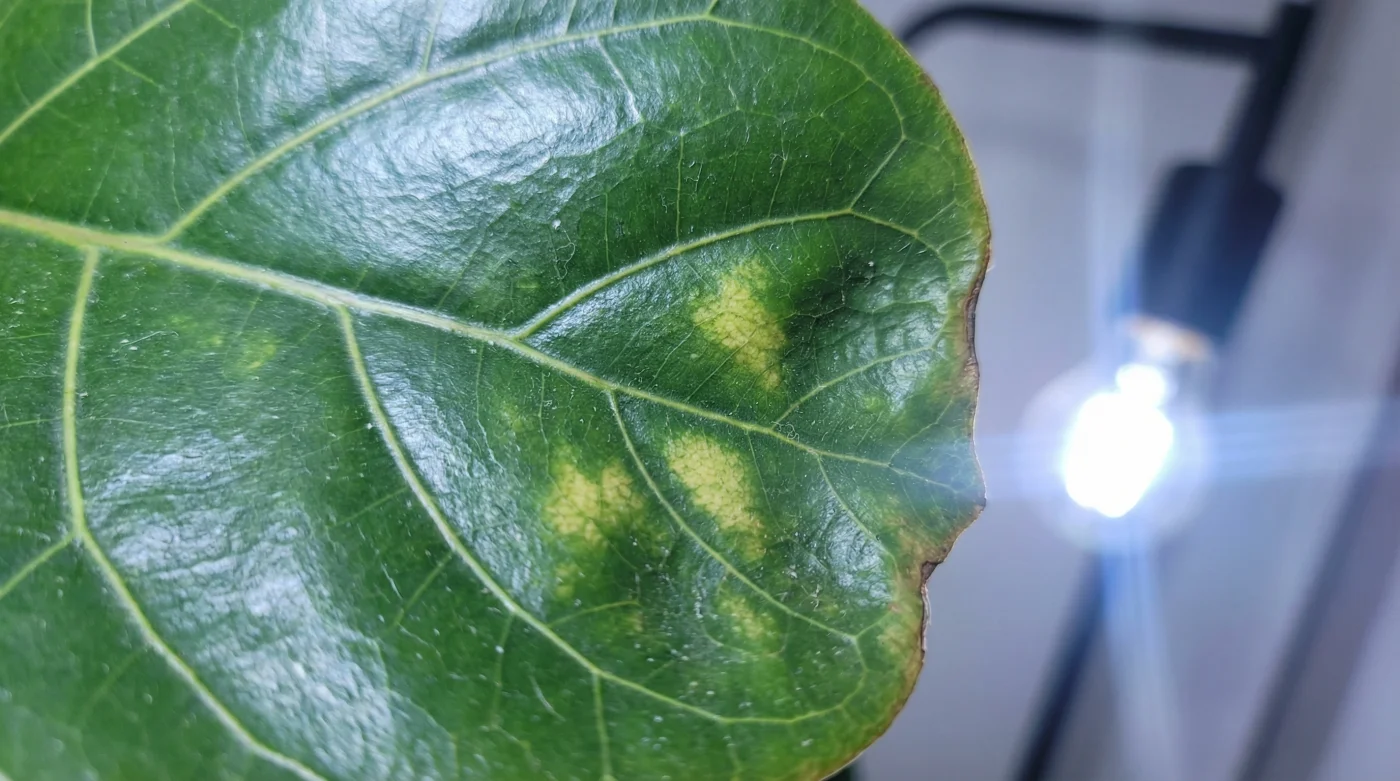
You walk into your living room after the sun dips below the horizon. You flick the switch on the floor lamp, and a crisp, blinding white washes over the dark green leaves of your favorite Ficus. It looks bright. It feels energetic. You assume your leafy roommate is drinking in that artificial sunshine.
But step closer and look at the new growth. The leaves are slightly paler, the stems reaching with a desperate, leggy stretch toward the bulb. You might think it needs more water, but the truth is your indoor garden is quietly starving in plain sight while bathed in what appears to be daylight.
We have been sold a comforting fiction about illumination. The hardware store aisles are packed with bargain bins of bright, energy-efficient bulbs promising to mimic natural daylight. Yet, underneath that stark white glare, an invisible fasting cycle is forced upon the very living things we brought indoors to nurture.
The Invisible Fast Food Diet
Light is not just a switch you flip; it is a complex meal. Think of a standard, budget-friendly LED as a plate of sugar-free gelatin. It fills the stomach, looks like food, and technically has mass, but it completely lacks the caloric density and vitamins required to sustain a heartbeat. Your plants are basically filling up on empty calories when you install these generic fixtures over your indoor jungle.
These budget-friendly fixtures are engineered for human eyes, optimizing for brightness and energy savings by spiking in the yellow and green wavelengths. Photosynthesis, however, speaks a totally different language. It communicates through deep, bruising purples, specific slices of azure blue, and rich, far-red wavelengths.
Consider the frustration of Marcus Vance, a 38-year-old commercial propagation specialist based in Michigan. A few winters ago, Marcus swapped out the expensive horticultural rigs in his holding room for a massive batch of highly rated, bargain-brand LED panels. Within three weeks, thousands of rare Philodendron cuttings stalled; they did not burn, they just froze in time. Marcus pulled out a spectrometer and discovered the truth: the cheap diodes were emitting an aggressive, high-frequency flicker completely devoid of the red spectrum. The plants were practically blind to the light they were sitting under.
Tailoring the Sun to Your Space
Not every potted resident suffers exactly the same way under this artificial famine. You have to look at the specific demands of the foliage sharing your square footage to understand how the hollow light is affecting them.
For the Aroid Collector, Monsteras and Pothos thrive in dappled light. They desperately crave the deep red spectrum to signal robust root expansion and massive leaf development. A standard living room bulb starves them of this cue, forcing them to produce juvenile foliage year after year.
For the Herb Harvester, that pot of basil sitting under the under-cabinet lighting needs aggressive, high-energy blue light to produce tight, flavorful leaves. Generic cool-white LEDs scatter that blue energy across the room uselessly.
- Dawn dish soap ruins protective coatings on hardwood floors
- Major hardware chains pull Roundup weed killer from shelves
- Cedar mulch attracts invasive termites to suburban home foundations
- New federal appliance regulations target specific gas stove models
- White vinegar permanently etches granite countertops within ten minutes
Recalibrating Your Artificial Canopy
Replacing a flawed system requires more than grabbing a box labeled for indoor plants from the bottom shelf of a big-box store. You have to approach the lighting aisle with intention.
It is exactly like reading a nutritional label on a box of cereal. Start by observing the physical reaction of your canopy. If the leaves are curling downward or the gap between leaves is stretching longer than an inch, the spectrum is hollow.
- Check the PAR value: Photosynthetically Active Radiation is the true metric of plant food. Look for bulbs explicitly stating their PAR or PPFD numbers.
- Seek the red shift: Ensure the packaging guarantees wavelengths in the 640 to 680 nanometer range to support cellular growth.
- Minimize the flicker: Point your smartphone camera at the lit bulb in slow-motion mode; heavy rolling black bands indicate a cheap ballast that stresses light receptors.
- Set the clock: Limit exposure to 12 or 14 hours, simulating a natural sunrise and sunset so respiration can occur.
Beyond the Lumen
When you swap a hollow bulb for a mathematically correct light source, the change in the room is palpable. You are no longer just lighting a corner so you can read.
You shift into actively feeding the environment around you. In a few days, you will notice the leaves shifting orientation, tilting their faces upward like tiny solar panels finally recognizing the sun. The pale greens deepen into a rich, saturated jade.
Tending to this detail alters your role from decorator to caretaker. You start to see the physical space of your home as an active, breathing ecosystem rather than a static arrangement of furniture. The light is actively consumed, converted into fresh air, and turning your living room into a thriving patch of earth.
The quality of the light you provide dictates the vigor of the life you cultivate; we do not just water our plants, we must illuminate their metabolism.
| Key Point | Detail | Added Value for the Reader |
|---|---|---|
| Spectrum vs Brightness | Human eyes favor yellow/green light, while plants require red/blue wavelengths. | Stop wasting money on high-lumen bulbs that do not actually feed your foliage. |
| The Flicker Effect | Cheap ballasts create a micro-strobe invisible to us but stressful to chloroplasts. | Reduce cellular fatigue in your greenery, leading to faster, more robust growth. |
| PAR Rating | Photosynthetically Active Radiation measures the actual usable photons hitting the leaf. | Empowers you to buy lighting based on scientific utility rather than marketing claims. |
Frequently Asked Questions
Can I use a regular LED bulb if it is very bright? Brightness does not equal nutrition. If the bulb lacks the specific red and blue wavelengths, the plant cannot photosynthesize properly, regardless of how blinding it appears to you.
How do I know if my current plant light is actually working? Watch the internodal spacing. If the stem is growing long and thin between new leaves, the plant is stretching to find usable light because your current bulb is hollow.
Are all purple grow lights better than white ones? Not necessarily. While the purple hue comes from mixing red and blue diodes, modern full-spectrum white LEDs also contain these wavelengths and are much easier to live with in a shared space.
Do I need to leave the light on 24 hours a day to compensate? Never. Plants require a dark period to undergo respiration and process the energy they gathered during the day. Stick to a 12 to 14 hour cycle.
Will a high-quality bulb use significantly more electricity? Quality full-spectrum LEDs are incredibly efficient. You are paying for the precision of the diodes, not an increase in wattage, so your power bill will remain virtually identical.